
Lifecycle-Separated Architecture
Architecture for Interoperability, Continuity, and Institutional-Boundary Preservation
Architecture Interpretation
The following interpretation describes the conceptual scope, architectural boundaries, and intended reading of the VeloxVFX architecture. It distinguishes selected technical roles from company services and institutional authority. The diagrams are conceptual public maps, not patent claim charts or specifications of every embodiment.
Conceptual Architecture Overview
These diagrams explain selected architecture concepts and responsibility boundaries. They do not depict a live service operated by VeloxVFX LLC.
Technical processing within a component and the legal authority of the responsible institution are distinct. Application-specific technical scope depends on the applicable patent record.
Arrows indicate possible information relationships. They do not prescribe a processing sequence, authorize an action, or transfer institutional authority.
Supervisory readability means information can support review; it does not confer supervisory authority. Continuity and audit-oriented traceability remain distinct from operational control and supervision.
Public presentation does not establish governmental or institutional adoption, deployment, endorsement, or implementation.
Upstream and Downstream: Read One Function at a Time
For a selected component, distinguish its source information, bounded processing, machine-readable output, and separate downstream use. This reading aid does not connect every family into one pipeline.
Input
Keep supplied records, their origin, and applicable conditions attributable.
Processing
Describe the selected transformation without assigning it every adjacent component’s responsibilities.
Output
Keep results, exceptions, and unresolved conditions distinguishable for review.
Handoff
Downstream use depends on the receiving environment and its governing conditions. An output does not automatically authorize the next action.
Lifecycle-Separated Continuity and Interoperability Model
This model illustrates the conceptual placement of VeloxVFX relative to independently governed operational environments. This selected view focuses on state readability, continuity, and evidence across independently governed institutions and systems. It does not define all technical operations within the portfolio.
The model does not represent an operational system, service offering, implementation requirement, or transaction-processing environment. Execution, settlement, custody, payment processing, regulatory determinations, supervisory actions, sanctions decisions, enforcement actions, and institutional approvals remain external to VeloxVFX and under the authority of the applicable institution, governmental body, agency, or authorized organization.
VELOXVFX LLC • Architecture
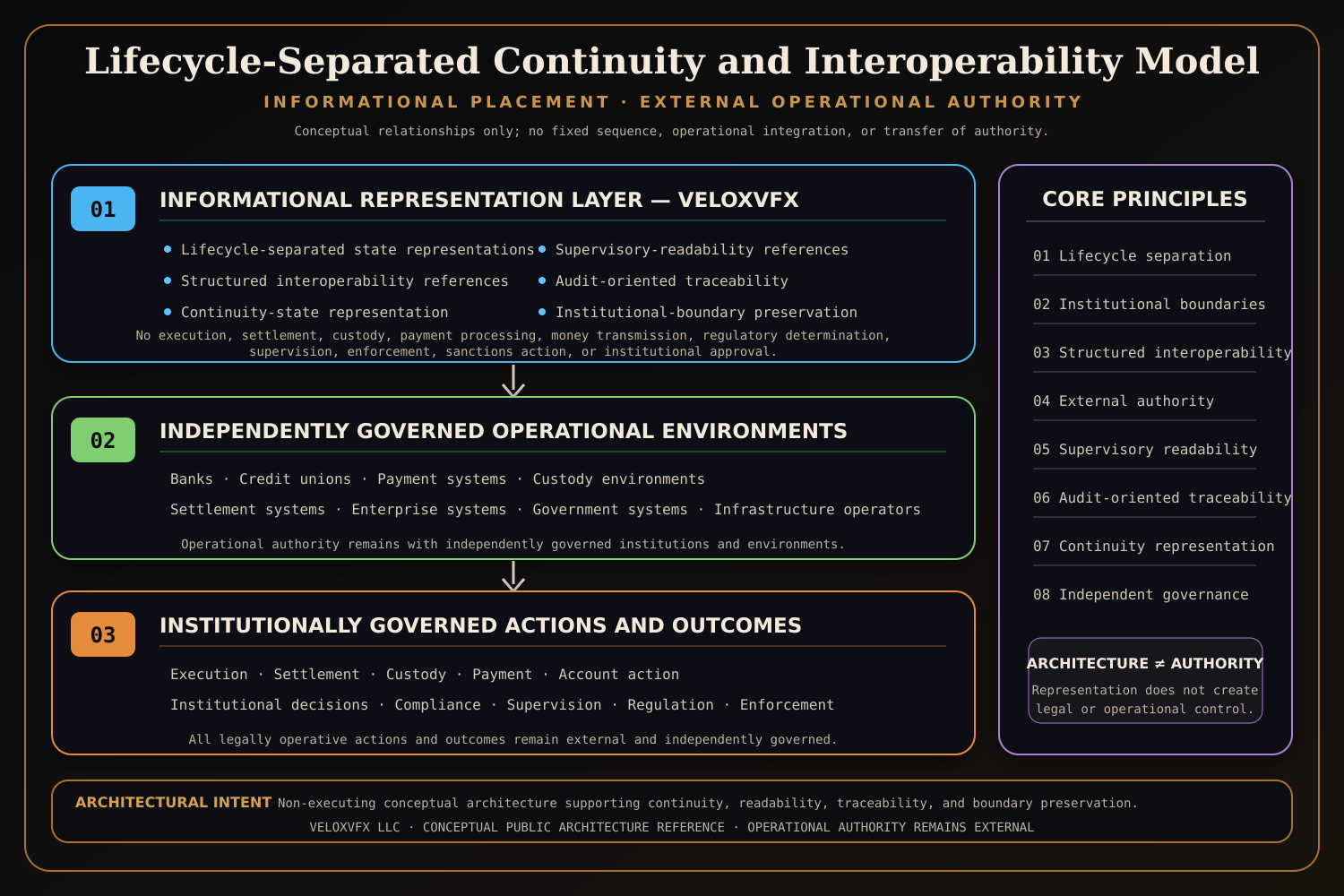
This diagram shows a selected information and reviewability view. Its arrows indicate possible information relationships, not a mandatory sequence or a transfer of authority. The illustration does not define the technical scope of every component. Responsible organizations retain their own legal authority and operational responsibilities.
Lifecycle-Separated Coordination Architecture
A non-linear public architecture map showing seven separately bounded principal functions: WHERE pathway/routing-state, WHETHER validation-state, PARAMETERS pre-execution conditioning, EVALUATION comparative evaluation, INSTRUCTION commercial instruction processing, REPLAY / RECOVERY control, and AUDIT / DISCLOSURE.
The functions may exchange information but do not merge, transfer authority, or require every transaction to use every function in a fixed sequence.
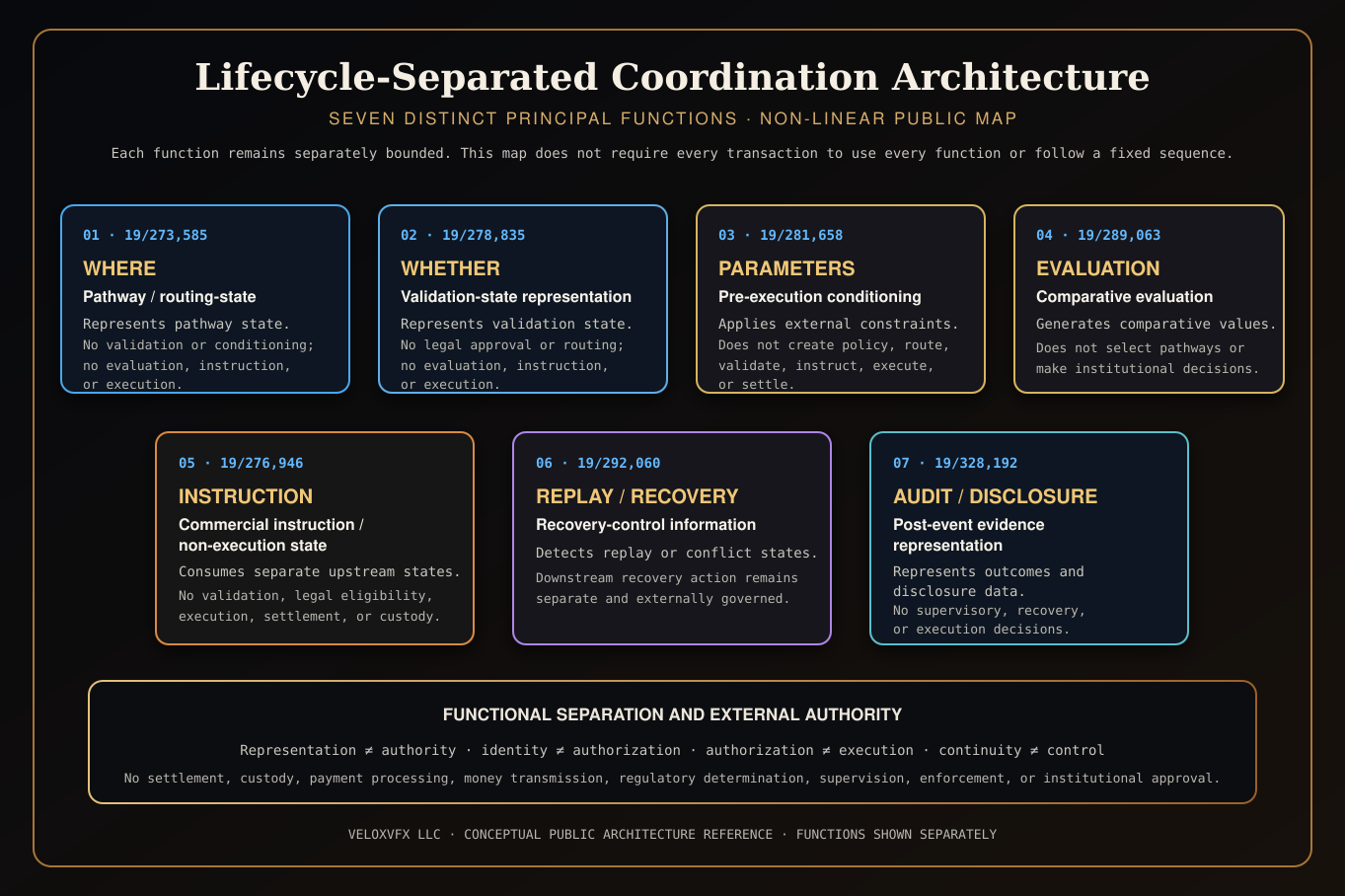
This diagram presents seven distinct public architecture roles without a mandatory processing order. Technical processing does not itself confer institutional or governmental authority. The map does not define application-specific claim scope.
Operational Boundary Preservation Architecture
Selected domain relationships, rather than a complete family inventory. A conceptual boundary-preservation framework illustrating how commercial, government-facing, custody, supervisory, infrastructure, and continuity domains may remain functionally distinct and independently governed while being represented through structured interoperability concepts. The framework is intended to support continuity, observability, and reviewability without merging institutional responsibilities, transferring authority, or implying operational integration.
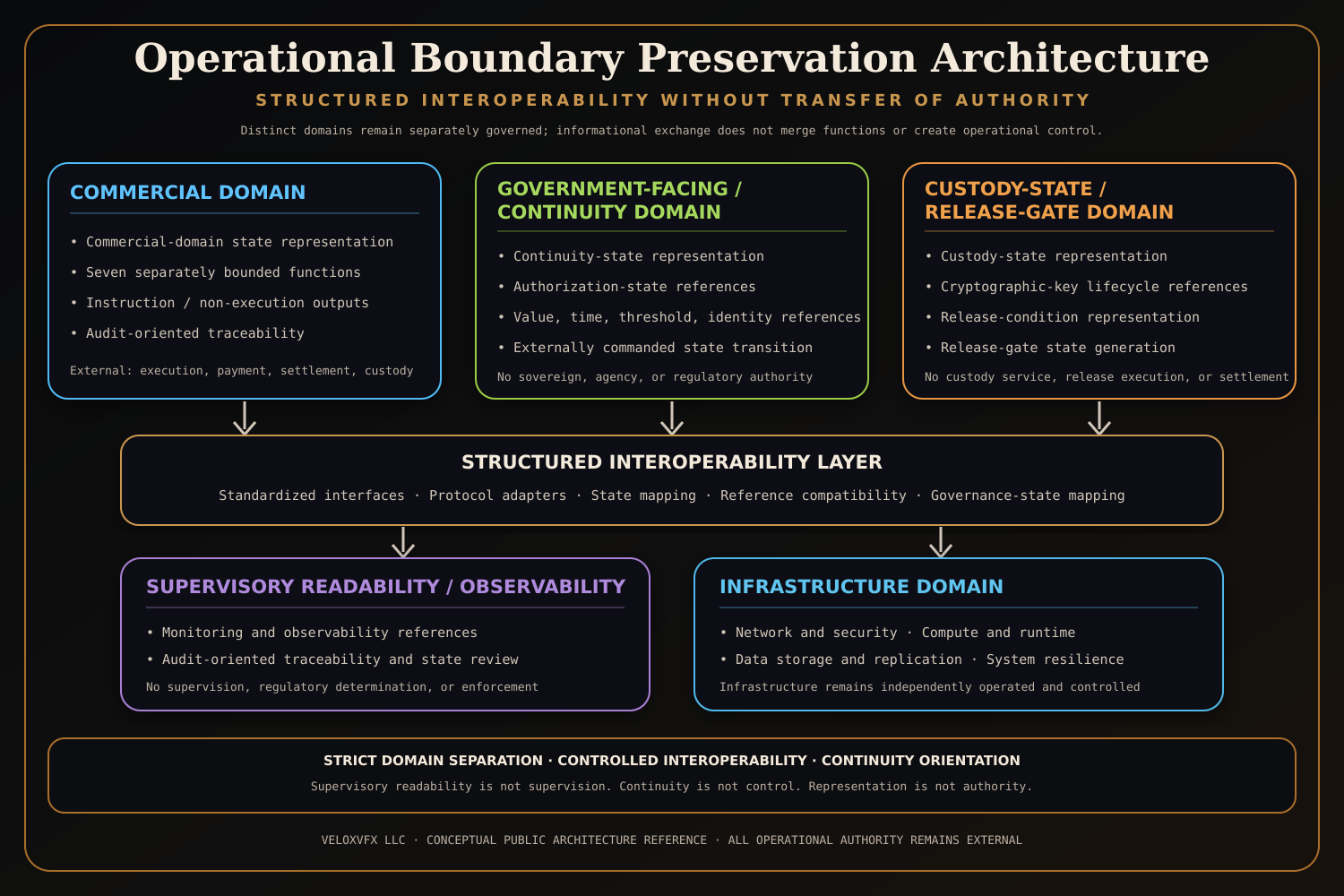
This diagram illustrates how distinct commercial, government-facing, custody, supervisory, continuity, infrastructure, and observability domains may be represented through structured interoperability concepts while remaining independently governed. It is intended to show institutional-boundary preservation, domain separation, supervisory readability, and continuity-oriented coordination without implying institutional consolidation, operational integration, agency adoption, or replacement of independently governed systems.
Separate Architecture Families — Public Domain Map
A public map of four distinct architecture families: VeloxFX in the commercial domain; USDCC / USDCR as the sovereign, government-facing family; FiVaultAI as the custody / release family; and BDGO as a standalone family.
Listing the families together does not establish a continuation, parent-child, subordinate, common-control, or implementation relationship among them.
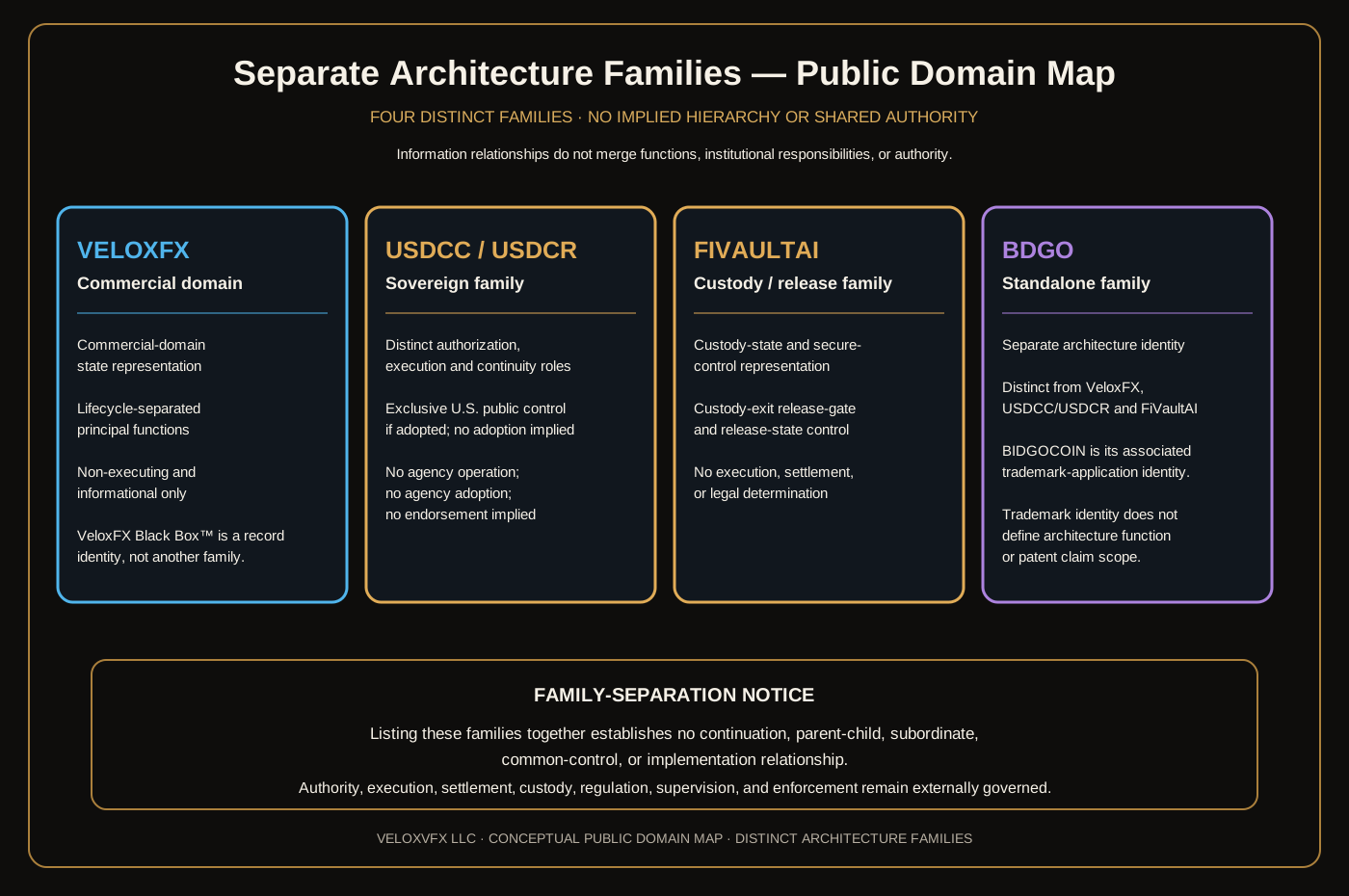
This diagram presents four separately bounded architecture families. BIDGOCOIN™ is identified only as the trademark-application identity associated with BDGO and does not define the BDGO patent architecture. The map does not imply agency adoption, institutional adoption, operational deployment, custody, settlement, payment processing, money transmission, stablecoin issuance, shared authority, or financial-service activity.
Diagram Boundary Statement
These architecture diagrams are presented as conceptual architecture references only. They do not represent an operational system, service offering, implementation requirement, institutional adoption, agency adoption, endorsement, procurement, operational integration, custody, settlement, payment processing, money transmission, stablecoin issuance, sovereign or governmental authority, regulatory authority, supervisory authority, enforcement authority, sanctions authority, account action, institutional decision-making, customer-asset control, or financial-service activity.
Commercial-Domain Processing Architecture
Application 19/276,946 identifies related commercial-domain patent work. This public overview distinguishes instruction-related processing from the legal authority of the responsible institution. The applicable patent record governs the technical subject matter disclosed and claimed.
Technical processing and institutional authority
Inputs, a bounded technical function, and machine-readable outputs describe a processing relationship. The responsible institution retains the legal authority governing any action.
This conceptual relationship does not specify the implementation or claim scope of Application 19/276,946.
Architecture Closing Statement
The VeloxVFX architecture is presented as a lifecycle-separated interoperability framework for conceptual state representation, continuity-oriented review, supervisory readability, audit-oriented traceability, and institutional-boundary preservation.
Across each architecture reference, operational authority remains external. Execution, settlement, custody, payment processing, account action, institutional approval or rejection, regulatory determinations, supervisory determinations, enforcement actions, sanctions actions, implementation decisions, and operational deployment remain subject to independently governed organizations acting within their own authority, responsibility, and legal obligations.
The purpose of the architecture is not to consolidate authority, replace institutions, operate financial infrastructure, or create dependency on a single system. The purpose is to clarify how distinct lifecycle domains may be represented, reviewed, and discussed through structured interoperability while preserving independently governed operational boundaries.
View the architecture diagrams at full size
Open an approved diagram in a separate tab to zoom and inspect its labels.
Independent public purpose
VeloxVFX independently contributes architecture-oriented public comments intended to complement documented agency objectives for harmonization and modernization where relevant, with the aim of supporting existing institutions without avoidable disruption. Each agency retains its own authority and requirements. Correspondence does not establish endorsement, adoption or demonstrated performance.