
ARCHITECTURAL FRAMEWORKS
Lifecycle-Separated
Interoperability Architecture Families
Across Commercial, Sovereign Government-Facing, Custody-State and Release-Gate, Standalone Architecture, Supervisory-Readability, and Infrastructure Domains
The VeloxVFX framework is organized as a collection of lifecycle-separated interoperability architecture families. Each family is presented as a distinct conceptual domain developed around continuity-oriented architecture, structured interoperability, supervisory readability, institutional-boundary preservation, and independently governed responsibilities.
This website explains selected public architecture concepts. It does not operate a financial or government service. These summaries are not patent claim charts; the applicable patent record governs the disclosed and claimed technical subject matter.
GENERAL INTELLECTUAL-PROPERTY AND OPERATIONAL BOUNDARY
References to pending patent applications, trademark filings, public-record materials, or framework identities reflect ongoing intellectual-property development and should not be interpreted as operational financial services, institutional affiliation, government or agency adoption, regulatory approval, deployment, custody, settlement, payment processing, money transmission, stablecoin issuance, private-equity participation, financial-instrument status, or independently governed operational control.
Function, Service, and Authority
Read each family on its own terms. A technical role, a company service, and an institution’s legal authority answer different questions.
Technical function
Identify inputs, bounded processing, output, and separate downstream use. These public summaries show selected roles rather than every implementation.
Company services
This website explains architecture concepts. It does not operate a banking, payment, custody, settlement, or government service.
Institutional authority
Each institution or public body retains its legally assigned decisions and responsibilities. Information exchange does not transfer that authority.
01 — COMMERCIAL-DOMAIN FAMILY
VeloxFX™-Lifecycle-Separated
Commercial-Domain Lifecycle-Separated Interoperability Architecture
VeloxFX™ presents commercial-domain lifecycle-separated architecture organized around seven separately bounded principal functions: WHERE pathway/routing-state, WHETHER validation-state, PARAMETERS pre-execution conditioning, EVALUATION comparative evaluation, INSTRUCTION commercial instruction processing, REPLAY / RECOVERY control, and AUDIT / DISCLOSURE.
These functions may exchange information but do not merge, transfer authority, or require every transaction to use every function in a fixed sequence. Institutional decisions and regulated activities remain with the responsible organizations under their own authority. Technical processing within a component does not confer that authority.
Framework components, application references, trademark identities, and boundaries
Framework Components
VeloxFX™
Commercial-Domain Lifecycle-Separated Interoperability Architecture
A commercial-domain framework that keeps seven principal lifecycle functions separately bounded while supporting structured interoperability and institutional-boundary preservation across independently governed environments.
AUDIT / DISCLOSURE — U.S. Patent Application No. 19/328,192
Post-Event Audit and Disclosure-State Architecture
A separately bounded post-event function processes outcome-related information, generates audit data and structured disclosure output, and preserves evidence for downstream review. It does not make audit, compliance, regulatory, or supervisory determinations and does not perform replay/recovery or transaction execution.
Trademark separation: VeloxFX Black Box™ is an associated pending trademark identity only. It does not define this architecture function, create another architecture family, or determine patent scope.
VELOXVFX LLC • Frameworks
Patent Architecture Continuity
These seven principal functions are separately bounded. They may exchange information, but they do not merge, transfer authority, or require every transaction to use every function in a fixed sequence.
Separate Portfolio Families — Public Filing Anchors
Family-separation notice: Each entry below belongs to a separate architecture family. Listing these public filing anchors together does not establish a continuation, parent-child, or subordinate relationship among the four families.
VeloxFX™: parent application 19/273,585 — filed July 18, 2025.
USDCC™ / USDCR™: parent application 19/304,431 — filed August 19, 2025.
FiVaultAI™: provisional application 63/846,933 — filed July 19, 2025; nonprovisional parent application 19/567,140 — filed March 15, 2026.
BDGO: standalone application 19/273,793 — filed July 18, 2025.
These are public filing and continuity references. They do not determine that every claim in a continuation-in-part receives the same effective filing date or establish claim-specific priority entitlement.
WHERE — U.S. Patent Application No. 19/273,585
Filing date: July 18, 2025 · Parent application
Pathway / Routing-State Architecture
Represents pathway-identification and routing-oriented states within a separately bounded lifecycle function. It does not determine validity, establish eligibility, authorize execution, process payment, transmit money, or conduct settlement.
WHETHER — U.S. Patent Application No. 19/278,835
Filing date: July 24, 2025 · CIP of U.S. Application 19/273,585
Validation-State Representation Architecture
Represents validation-related review states for externally supplied information. It does not determine identity, establish legal eligibility, originate authorization, select a routing pathway, execute a transaction, or make a legally operative compliance determination.
PARAMETERS — U.S. Patent Application No. 19/281,658
Filing date: July 27, 2025 · CIP of U.S. Application 19/273,585
Pre-Execution Parameter Conditioning Architecture
Applies defined, externally supplied constraints and state information to parameter data and produces conditioned parameters for downstream use. It does not create law or policy, select a pathway, validate, generate an instruction, execute, or settle.
EVALUATION — U.S. Patent Application No. 19/289,063
Filing date: August 3, 2025 · CIP of U.S. Application 19/273,585
Comparative Evaluation Architecture
Generates comparative values concerning externally defined pathways for downstream use. It does not identify, select, or determine a pathway, execute a transaction, or make a legal or institutional decision.
INSTRUCTION — U.S. Patent Application No. 19/276,946
Filing date: July 22, 2025 · CIP of U.S. Application 19/273,585
Commercial-Domain Processing Architecture
Application 19/276,946 identifies related commercial-domain patent work. The public model distinguishes instruction-related processing from the legal authority of the responsible institution. The applicable patent record governs the technical functions disclosed and claimed.
REPLAY / RECOVERY — U.S. Patent Application No. 19/292,060
Filing date: August 6, 2025 · CIP of U.S. Application 19/273,585
Replay-State Detection and Recovery-Control Architecture
The replay/recovery function detects replay-related conditions and produces bounded recovery-control information for separate downstream processing. Technical recovery control does not confer legal authority to reverse an action or alter finality, and remains separate from transaction execution and audit-record generation.
AUDIT / DISCLOSURE — U.S. Patent Application No. 19/328,192
Filing date: September 14, 2025 · CIP of U.S. Application 19/273,585
Post-Event Audit and Disclosure-State Architecture
Processes outcome-related information, generates audit data and structured disclosure output, and preserves post-event evidence for downstream review. It does not make audit, compliance, regulatory, or supervisory determinations and does not perform replay/recovery or transaction execution.
VELOXVFX LLC • Frameworks
Official Trademark Records
VeloxFX™
U.S. Trademark Application Serial No. 99298794
View VeloxFX™ 99298794 Record 07-23-2025
VeloxFX Black Box™
U.S. Trademark Application Serial No. 99391858
View VeloxFX Black Box™ 99391858 Record 09-14-2025
VeloxFX Black Box™
U.S. Trademark Application Serial No. 99379422
View VeloxFX Black Box™ 99379422 Record 09-08-2025
Related Architecture Layers
WHERE — Pathway / Routing-State
Pathway-identification and routing-oriented state representation without validation, authorization, payment processing, or settlement.
WHETHER — Validation-State Representation
Validation-related state review without identity determination, legal judgment, routing selection, or execution authority.
PARAMETERS — Pre-Execution Parameter Conditioning
Applies defined constraints and supplied state information to parameter data, modifies that data, and produces conditioned parameters for separate downstream use. Conditioning does not originate law, policy or institutional authorization.
EVALUATION — Comparative Evaluation
Comparative assessment of externally defined pathways without pathway selection, supervision, enforcement, or operational control.
INSTRUCTION — Commercial Instruction Processing
Instruction-related processing is a distinct public architecture role. Technical processing does not itself confer institutional authority.
REPLAY / RECOVERY — Recovery-Control State
Detects replay-related conditions and produces bounded recovery-control information; recovery history remains reviewable. Technical recovery control does not confer legal reversal authority.
AUDIT / DISCLOSURE — External Audit Use
Generates audit data and structured disclosure output from outcome-related information, without an auditor’s opinion, supervisory judgment, compulsory disclosure authority or legally operative compliance determination.
VELOXVFX LLC • Frameworks
Commercial-Domain Separation Principle
Routing is not validation.
Validation is not authorization.
Parameter conditioning is not policy creation.
Comparative evaluation is not pathway selection or supervision.
Instruction processing does not itself confer legal authority to act.
Replay and recovery control is not reversal authority.
Audit and disclosure-state representation is not regulatory oversight.
Interoperability is not institutional integration.
Architecture is not authority.
Commercial-Domain Boundary
VeloxVFX LLC and VeloxFX™ present lifecycle-separated informational architecture concepts. They do not operate as a bank, financial institution, payment processor, money transmitter, settlement operator, custodian, exchange, broker, clearing organization, governmental authority, regulatory authority, supervisory authority, enforcement authority, sanctions authority, or sovereign monetary authority.
VeloxVFX LLC does not hold, receive, transmit, settle, safeguard, or control customer funds or assets through this website. This public presentation does not issue currency, stablecoins, deposits, securities, investment products, or financial instruments. This website does not make legally operative identity, eligibility, authorization, or compliance determinations, execute transactions, process payments, conduct settlement, or exercise institutional authority.
All legally operative decisions, authorizations, execution, payment processing, custody, settlement, compliance determinations, supervision, enforcement, and governmental functions remain with independently authorized organizations acting within their respective authority.
Presentation of this architecture does not imply affiliation, adoption, endorsement, approval, procurement, implementation, institutional integration, operational use, or reliance by any government, agency, financial institution, market infrastructure, technology provider, or other organization.
VELOXVFX LLC • Frameworks
Illustrative architecture concept only. The diagram does not represent operational deployment, legally operative transaction execution, payment processing, custody, settlement, regulatory authority, or institutional adoption.
Seven distinct commercial architecture roles
Pathway-related processing
Condition-related review
Defined parameter processing
Comparative values
Instruction-related processing
Recovery processing and history
Evidence and disclosure information
These roles may exchange information without forming a mandatory sequence. Each responsible institution retains its legal authority. This conceptual map does not define application-specific claim scope or represent a live service.
02 — SOVEREIGN ARCHITECTURE FAMILY
USDCC™ / USDCR™
Separate functions. Public authority retained.
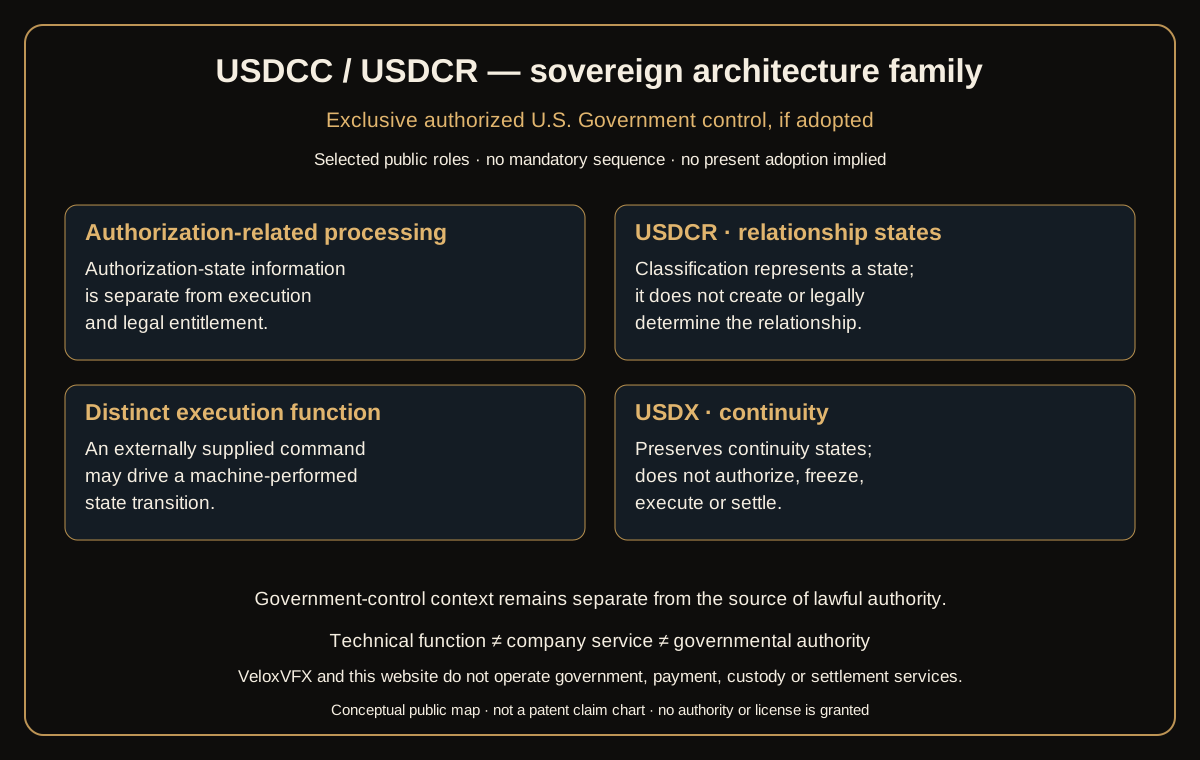
USDCC / USDCR is a proposed sovereign architecture family, separate from the other families, designed for exclusive authorized U.S. governmental control if adopted by the United States Government. USDX is a bounded continuity context within this family. This design requirement does not establish present adoption, deployment, ownership, endorsement or operational control.
The family keeps authorization-related processing, government-control context, separately bounded execution and continuity distinct. Technical processing does not create governmental authority. A public summary does not determine every application’s technical scope.
Family roles, public filing references, trademark identities and boundaries
Authorization and relationship states
Authorization-related processing and authorization-state information remain distinct from transaction execution and from the legal authority to approve an action. Representing a state does not itself grant legal entitlement or governmental power.
USDCR identifies relationship-state classification: representing a relationship state does not create, approve or legally determine the underlying relationship. The associated trademark identity does not define the technical scope of an individual patent application.
Execution is a distinct technical role
A separately bounded sovereign execution function may carry out an externally supplied command through a machine-performed state transition. It remains distinct from authorization, control context and continuity. This does not mean VeloxVFX or the public website operates that function or possesses governmental authority.
USDX — continuity
USDX represents and preserves continuity-related states within the sovereign family. Continuity does not authorize an action, freeze or control value, issue or redeem currency, execute a transaction, or conduct settlement. It is not a fifth architecture family.
Public patent-application references
These references identify related patent work. They are not claim charts or a statement of current examination status. The applicable patent record governs disclosed and claimed technical subject matter.
- 19/304,431 — Parent; filed August 19, 2025. Authorization-related processing remains distinct from execution.
- 19/310,864 — CIP of 19/304,431; filed August 26, 2025. Government-control context does not itself confer governmental authority.
- 19/321,283 — CIP of 19/304,431; filed September 7, 2025. Separately bounded government-facing patent work; this selected public summary does not define its application-specific processing.
- 19/276,661 — CIP of 19/304,431; filed September 23, 2025. Separately bounded execution remains distinct from the source of governmental authority.
- 19/572,075 — CIP of 19/304,431; filed March 19, 2026. USDX continuity remains non-authorizing and non-executing.
Filing metadata is retained from the previously published continuity references. Filing dates do not establish claim-specific priority entitlement, allowance or deployment.
Trademark identities remain separate
USDCC T-BILL is a separately identified pending trademark-application identity within the sovereign family. Its name does not establish a security, reserve-management service, investment product, financial return or settlement operation, and does not define architecture function or patent scope.
- USDCC — U.S. trademark application 99346460. View USPTO record.
- USDCC — U.S. trademark application 99417388. View USPTO record.
- USDCC T-BILL — U.S. trademark application 99424961. View USPTO record.
- USDCR — U.S. trademark application 99535278. View USPTO record.
Service and authority boundary
Governmental authority remains exclusively with legally authorized U.S. institutions. No private architecture, license, payment or public-benefit contribution confers governmental authority, ownership or equity in the United States government, or a right to control governmental decisions. VeloxVFX LLC and this website do not operate a government, payment, custody or settlement service.
Publication of a company comment establishes public availability, not agency adoption, endorsement, approval, reliance, procurement or implementation. No public page or agent response grants a license or discloses protected patent or implementation material.
03 — CUSTODY-STATE AND RELEASE-GATE FAMILY
FiVaultAI™-Lifecycle-Separated
Custody-State and Release-Gate Architecture
FiVaultAI™ comprises separately bounded custody-state and cryptographic-key lifecycle processing, together with a distinct custody-exit release gate. The release gate governs whether transaction-instruction information may leave a custody environment for downstream use. These functions remain separate from institutional authorization, transaction execution and settlement.
Technical custody-state processing and instruction-release gating are distinct from company services. VeloxVFX LLC does not itself offer custodial services or take possession of customer assets or keys through this public website.
Framework components, application references, trademark identities, and boundaries
Separately Bounded Functions
Custody-state and cryptographic-key lifecycle
The custody-state function maintains structured custody-state data, cryptographic-key lifecycle information, identity-linked access conditions, and persistence across system environments. Its output remains separate from transaction authorization, transaction-execution control signals, execution, replay and audit-record generation.
Custody-exit release gating
The release gate determines a release state from custody-linked information and externally generated state inputs, controls whether transaction-instruction information may leave a custody environment, and outputs release-state data for separate downstream processing. Technical gating is not asset transfer, transaction execution, settlement or originated institutional authorization.
Patent Architecture Continuity
U.S. Patent Application No. 19/567,140 — custody-state and asset-environment representation.
U.S. Patent Application No. 19/572,259 — separately bounded custody-exit release gating.
These public application references do not certify current examination status, allowance or claim scope. The applicable patent record governs disclosed and claimed technical subject matter.
Official Trademark Record
FiVaultAI™
U.S. Trademark Application Serial No. 99461716
View FiVaultAI™ USPTO Record 10-24-2025
Trademark identity does not create another architecture family or determine architecture function or patent scope.
External Review and Institutional Authority
Custody-state and release-state outputs may support external review. These functions do not generate audit records, exercise supervision, make legally operative compliance determinations or confer governmental authority.
Independent institutions and operators retain their own authorization, custody-service responsibilities, asset transfers, transaction execution, settlement and legally assigned decisions. Technical access conditions and release gating do not replace those responsibilities.
Architecture and Service Boundary
VeloxVFX LLC does not administer escrow, take possession of customer assets or keys, manage reserves, execute transactions, process payments, transmit money or conduct settlement through this public website. A technical architecture function and a service offered by the company are different questions.
Presentation does not establish deployment, affiliation, adoption, endorsement, approval, procurement, institutional integration or use by a government, agency or institution.
VELOXVFX LLC • Frameworks
04 — STANDALONE ARCHITECTURE FAMILY
BDGO
Standalone architecture family
BDGO is a standalone architecture family, separate from VeloxFX, USDCC/USDCR and FiVaultAI. BIDGOCOIN is its associated trademark-application identity. Trademark application status and wording do not define architecture function or patent claim scope.
Architecture identity and public filing references
Separate patent and trademark identities
U.S. patent application 19/273,793 — filed July 18, 2025. BIDGOCOIN trademark application serial 99278288 — filed July 11, 2025.
These public identification references do not establish current prosecution status, patent allowance, claim scope, deployment or institutional adoption.
Family separation
BDGO is not an additional VeloxFX lifecycle function, a FiVaultAI component, or a sovereign execution function. No fixed processing pipeline, hierarchy or transfer of authority is implied.
Public description boundary
The maintained public description establishes standalone identity and family separation. It does not infer a functional definition from the trademark name or another architecture family. Technical functions and patent scope require their own applicable source records.
Operating boundary
VeloxVFX LLC does not operate an exchange, brokerage, escrow, custody, payment or settlement service through this public website. Architecture identification is not operational deployment or governmental authority.
Cross-Family Separation Principle
The four VeloxVFX architecture families remain independently bounded according to their respective domains and principal lifecycle functions.
Commercial-domain instruction-state generation is not custody-support architecture.
Custody-state representation is not transaction-environment operation.
BDGO remains a standalone architecture family, separate from the sovereign family.
Government-facing continuity-state representation is not sovereign authority.
Routing is not validation.
Evaluation is not routing.
Parameter conditioning is not authorization.
Instruction-state generation is not legally operative institutional execution.
Continuity is not control.
Release gating is not release execution.
External audit use is not audit-record generation or supervision.
Structured interoperability does not consolidate institutional authority.
Architecture is not authority.
Public-Record Reference Notice
References to patent applications, trademark records, governmental materials, public comments, agency publications, or other public records are provided for informational and architecture-oriented identification only.
A public filing or correspondence record does not establish agency access, awareness, influence, causation, reliance, affiliation, adoption, endorsement, approval, procurement, implementation, operational integration, patent validity, patent enforceability, legal equivalence, or infringement.
Official governmental and USPTO records remain authoritative. Application numbers identify pending or publicly available records and do not represent the issuance of a patent, final agency determination, or governmental validation of the architecture.
Global Boundary Statement
VeloxVFX LLC presents lifecycle-separated informational architecture concepts. VeloxVFX LLC is not a bank, financial institution, payment processor, money transmitter, settlement operator, custodian, stablecoin issuer, exchange, broker, clearing organization, governmental authority, regulatory authority, supervisory authority, enforcement authority, sanctions authority, or sovereign monetary authority.
This public website does not execute transactions, control customer assets, make legally operative institutional decisions, or exercise governmental authority. That service boundary does not define the technical scope of every patent embodiment.
All legally operative decisions, authorization, execution, payment processing, settlement, custody, compliance determinations, supervision, enforcement, sanctions administration, and governmental functions remain with independently authorized organizations acting within their respective authority.
VeloxVFX LLC does not provide financial, legal, tax, regulatory, compliance, or investment advice. Presentation of these concepts does not imply affiliation, adoption, endorsement, approval, procurement, implementation, institutional integration, or operational use by any government, agency, financial institution, market infrastructure, technology provider, or other organization.
VELOXVFX LLC • Frameworks
The objective is not consolidation.
The objective is structured coordination.
Independent public purpose
VeloxVFX independently contributes architecture-oriented public comments intended to complement documented agency objectives for harmonization and modernization where relevant, with the aim of supporting existing institutions without avoidable disruption. Each agency retains its own authority and requirements. Correspondence does not establish endorsement, adoption or demonstrated performance.